Quick answer
The short version
COSHH stands for the Control of Substances Hazardous to Health Regulations 2002. It's the law that covers anything you work with on site that could harm your health, cement, silica dust, wood dust, welding fume, solvents, and more. If a substance you use or create at work could hurt someone through breathing it in, touching it, or swallowing it, COSHH says you need to work out the risk, put controls in place, and write it down.
In short
Key takeaways
- COSHH covers chemicals, dust, fumes, gases, and biological agents, not just bottled chemicals with warning labels.
- A COSHH assessment is a separate document from your general risk assessment, it focuses only on hazardous substances.
- Safety data sheets from suppliers inform your assessment but don't replace the need to do one yourself.
- PPE, including respirators, is the last control you reach for, not the first.
- All welding fume is now treated as a cancer risk, regardless of the metal being welded.
- If you employ five or more people, you must record the findings of your COSHH assessments in writing.
What Is COSHH and Does It Apply to You?
COSHH is short for the Control of Substances Hazardous to Health Regulations 2002 (SI 2002/2677). It's a piece of law, not a company policy or a good idea someone had, and it applies to anyone who uses, stores, or creates a substance at work that could damage health. On a construction site that net is wider than most people expect. It's not just tins of solvent or bags of chemical with a hazard symbol on the label. Cement, brick dust, wood dust, welding fume, and even some naturally occurring materials disturbed by the work count as hazardous substances under COSHH.
If you're a sole trader mixing your own mortar, you're covered by COSHH just as much as a contractor running a site with fifty people on it. The regulations apply to employers and the self-employed alike. What changes with size isn't whether COSHH applies, it's the paperwork duty attached to it. Employers with five or more employees have to record the findings of their COSHH assessments in writing. Below that threshold you still need to do the assessment and act on it, you just aren't legally required to write it down, though doing so anyway is good practice and makes it a lot easier to prove what you did if anything is ever questioned.
COSHH applies to any route the substance could get into the body: breathing it in as dust, fume, or vapour, absorbing it through the skin, getting it in the eyes, or swallowing it through contaminated hands or food. It also covers substances your work creates rather than ones you bring to site, cutting a slab creates silica dust that wasn't there in bag form, and welding creates fume that didn't exist before the arc was struck. Both are covered.
Definition
COSHH
The Control of Substances Hazardous to Health Regulations 2002 require employers and the self-employed to assess the risk from any substance hazardous to health used or created at work, put controls in place to prevent or reduce exposure, and, in most cases, keep a written record of that assessment.
Common Hazardous Substances on Construction Sites
Most trades handle several COSHH substances a day without necessarily thinking of them that way. Here are the ones that come up most often on construction work.
Checklist
- Cement and concrete, wet cement is alkaline and causes dermatitis and chemical burns on contact with skin
- Silica dust, released when cutting, drilling, or grinding brick, block, concrete, or stone
- Wood dust, from sawing and sanding both softwood and hardwood, with hardwood dust carrying a higher risk
- Welding fume, produced by all welding processes and now classed as carcinogenic regardless of the metal
- Solvents and adhesives, found in paints, thinners, contact adhesives, and some sealants
- Isocyanates, found in some spray foams and two-pack paints, a leading cause of occupational asthma
- Paint and coatings, including older paints that may contain lead
- Fuel and oil, from plant, generators, and hand tools, with skin and inhalation risks from prolonged contact
Some of these carry Workplace Exposure Limits, WELs, which are legal limits on how much of a substance a worker can be exposed to over a set period, usually 8 hours or 15 minutes. The full list of substances with a WEL, and what that limit is, sits in the HSE's EH40 document. If a substance you're using has a WEL listed in EH40, your controls need to keep exposure below it, not just close to it. For a closer look at silica, wood dust, and welding fume specifically, including the exact WEL figures and how the controls differ between them, see our guide to construction dust and COSHH.
How to Do a COSHH Assessment: Step by Step
A COSHH assessment isn't the same thing as your general risk assessment. Your risk assessment looks at the whole job, working at height, moving vehicles, manual handling, and everything else. A COSHH assessment looks specifically at the hazardous substances involved and what you're doing to control exposure to them. On most jobs you'll need both, and they should cross-reference each other.
Step by step
- 1IdentifyList all hazardous substances used or likely to be encountered on the job
- 2Find the hazardsRead safety data sheets (SDS) for each substance. Check for health hazards, exposure limits (WELs), and first-aid measures
- 3Assess who is affected and howWho handles the substance, for how long, how often, and through what route (inhalation, skin contact, ingestion)
- 4Decide on controlsFollow the hierarchy: eliminate, substitute, control at source (extraction/ventilation), then PPE as last resort
- 5Record your findingsWrite down the substance, its hazards, the controls you are using, and who is responsible
- 6Inform and trainMake sure everyone handling the substance knows the risks and controls
- 7ReviewUpdate when substances change, controls fail, or after any incident
The order of the "decide on controls" step matters more than any other part of the process. Schedule 2A of the regulations sets out eight principles of good practice for controlling exposure, and they run in a specific order of preference: design the process to avoid the hazard in the first place, substitute for something less hazardous, control exposure at source, only use PPE where the above doesn't reduce risk enough, control exposure using a combination of measures matched to the risk, keep exposure below any WEL, check the effectiveness of controls through personal hygiene measures, and monitor exposure where necessary. If your assessment jumps straight to "wear a mask" without considering whether the dust could be controlled at source with water suppression or extraction, it hasn't followed the hierarchy properly. Our guide to the hierarchy of controls covers this in more depth if you want the full reasoning behind the order.
Understanding Safety Data Sheets
Safety data sheets, SDS, are required from suppliers under the REACH Regulation for any substance classified as hazardous. Every SDS follows the same 16-section format, so once you know where to look, you can find the same information regardless of who made the product. They're a starting point for your assessment, not a substitute for doing one. A supplier's SDS tells you about the substance in general, it doesn't know how you're going to use it, for how long, or in what space.
The sections worth reading closely are Section 2, hazard identification, which tells you what the substance can do to you; Section 8, exposure controls and personal protection, which lists the WEL if one applies and recommends the type of PPE and ventilation needed; Section 4, first-aid measures, so you know what to do if someone's exposed; and Section 7, handling and storage, which covers how to keep the substance safely on site. Section 15 confirms the regulatory status, useful if you need to check whether something is classified as a carcinogen or respiratory sensitiser.
Keep the SDS for every hazardous substance on site somewhere accessible, not filed away in an office miles from where the work's happening. If someone's exposed and needs treatment, the first-aid section of the SDS can matter more than anything else in the document.
RPE and PPE for Common Construction Substances
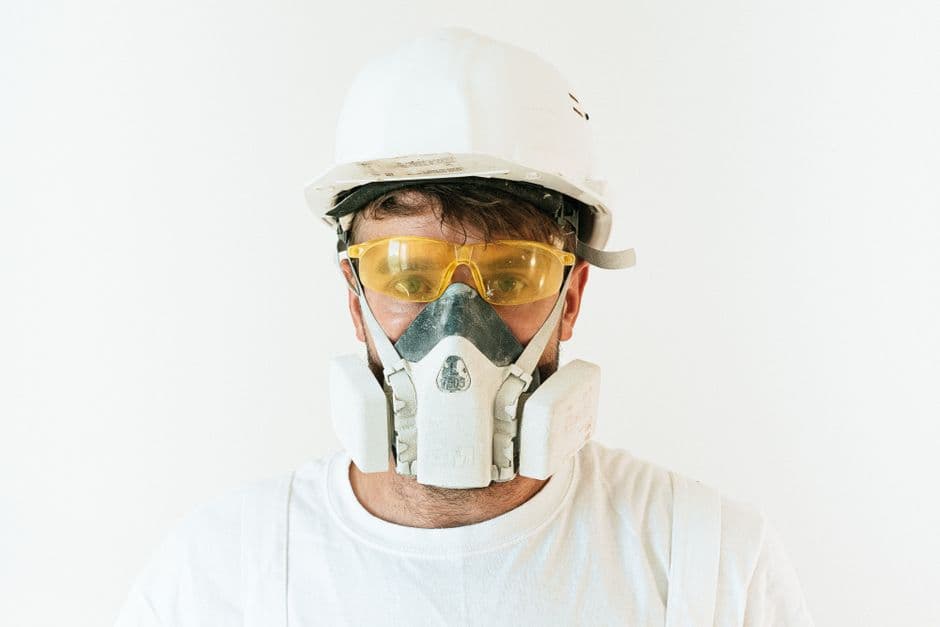
Respiratory protective equipment, RPE, needs to match the substance you're working with, not just be "a mask." FFP2 filters out a reasonable proportion of general dust, but fine dusts like silica and welding fume need FFP3 or better. For higher-risk or prolonged exposure, a half-face respirator fitted with P3 filters gives a better seal and more reliable protection than a disposable mask, particularly for anyone who struggles to get a good seal with a filtering facepiece.
RPE and PPE by Substance
| Substance | Main Risk | RPE / PPE Required |
|---|---|---|
| Cement | Dermatitis, burns | Gloves (PVC/nitrile), long sleeves |
| Silica dust | Silicosis, lung cancer | FFP3 mask or powered respirator |
| Welding fume | Lung cancer, metal fume fever | FFP3 mask or welding respirator |
| Wood dust (hardwood) | Asthma, nasal cancer | FFP2 minimum |
| Solvents/adhesives | Dizziness, headaches, long-term organ damage | FFP2 in poorly ventilated spaces |
Remember that RPE only works if it fits. A disposable FFP3 mask that doesn't seal against the face because of stubble, the wrong size, or a badly fitted strap gives a fraction of its rated protection. A fit test isn't a box-ticking exercise, it's the only way to know a given mask actually seals on a given face. PPE and RPE sit at the bottom of the control hierarchy for a reason, they protect the individual wearing them and do nothing to reduce the hazard for anyone else nearby, so they should always sit alongside other controls like extraction or water suppression, not instead of them.
Local Exhaust Ventilation: What You Need to Know
Local exhaust ventilation, LEV, is equipment designed to capture dust, fume, or vapour at the point it's created, an on-tool extraction unit on a grinder, a fume extractor on a welding station, or a fixed extraction system in a workshop. It's one of the most effective controls available because it stops the hazard reaching the worker's breathing zone in the first place, rather than relying on a mask to filter it out afterwards.
Under Regulation 9 of COSHH, any LEV system in use must be thoroughly examined and tested by a competent person at least every 14 months, and more often for certain higher-risk processes. This isn't the same as a quick visual check before you plug it in. It's a proper examination that confirms the system is still capturing dust effectively, and it needs to be recorded. If you're relying on LEV as your main control for a substance like silica or welding fume, an out-of-date or ineffective LEV system means your control isn't actually working, whatever your paperwork says.
Keep the LEV examination certificate with your other site records, and don't assume a unit is doing its job just because it's switched on and making noise. Airflow indicators, visual checks for damaged ducting, and worn filters are all things worth checking between formal examinations too.
Common Mistakes
Common mistakes
- Treating the safety data sheet as the COSHH assessment instead of using it as one input into your own assessment.
- Reaching for a dust mask before considering whether the dust could be controlled at source with water or extraction.
- Using FFP2 masks for silica or welding fume when FFP3 is the minimum needed.
- Assuming COSHH doesn't apply because nothing on site has a hazard label, cement, wood dust, and welding fume are all covered without one.
- Letting LEV examination certificates lapse past the 14-month mark.
- Not recording COSHH assessment findings even though the business has five or more employees.
- Failing to update the assessment when the substance, task, or duration of exposure changes.
Important safety warning
HSE clamped down on welding fume in 2019 after research confirmed that fume from all welding processes, on any metal including mild steel, can cause lung cancer. There's no "safe" metal to weld without proper controls. Silica dust carries a similar long-term risk, silicosis and lung cancer develop from repeated exposure over years, often with no symptoms until the damage is already done. Both are reasons to get the controls right at the time, not after someone's diagnosed.