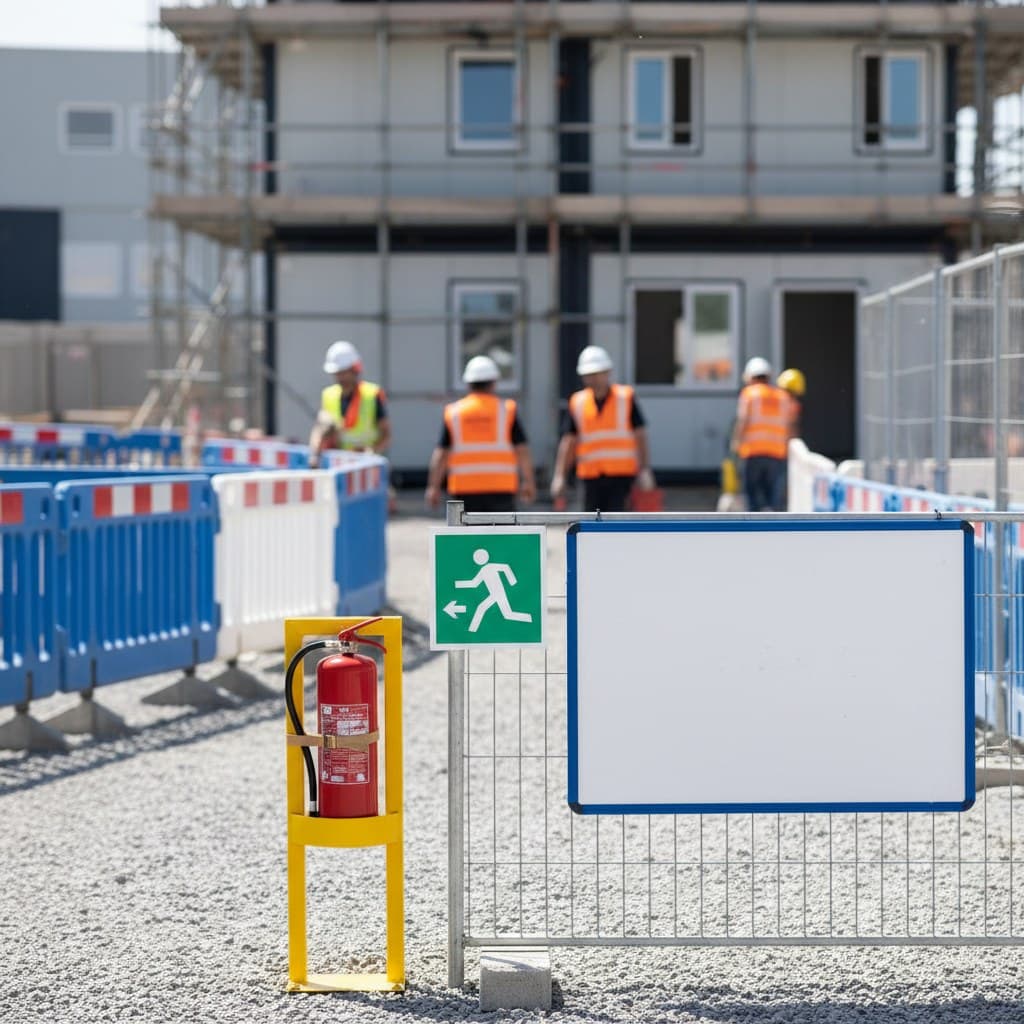
A construction site is a temporary workplace. Unlike a finished office block or factory, it has no built-in fire safety. There's no wired-in detection, no permanent escape signage and no settled layout. Half of it is scaffolding and timber, and a fair chunk of the materials around you will burn given half a chance.
That's why fire safety on construction sites has to be built in from day one, before the first wall goes up. The law puts this on you through a fire risk assessment and the emergency arrangements in the construction phase plan, and your RAMS is where you record how each task keeps those controls in place. Get it right and a fire stays a near miss. Get it wrong and one stray spark can take the whole job with it.
This guide runs through the law, the risk assessment, hot work, escape routes and flammable storage in plain English. No compliance-speak, just what you actually need to do on site.
Summary
At a glance
- Who it is for
- Small contractors, site managers and principal contractors on sites in England, Wales and Scotland
- Main law
- Regulatory Reform (Fire Safety) Order 2005 (England and Wales)
- Key duty holder
- The responsible person, usually the principal contractor
- Best next step
- Do a fire risk assessment and put the precautions in the construction phase plan
Fire Safety on Construction Sites: The Law
The main law is the Regulatory Reform (Fire Safety) Order 2005, also known as the RRFSO (SI 2005/1541). It applies in England and Wales. It does not apply in Scotland, where the Fire (Scotland) Act 2005 covers the same ground instead. If you're working across the border, don't assume the same rules follow you. Northern Ireland has its own fire safety regime under the Fire and Rescue Services (Northern Ireland) Order 2006, and its own construction regulations, so this guide doesn't cover it.
The RRFSO is built around one key role: the responsible person. Under Article 9, the responsible person must carry out and keep up to date a suitable and sufficient fire risk assessment. Article 8 sets out general fire precautions that must be taken so far as is reasonably practicable. And Article 14 is blunt about escape routes and exits: they must be kept clear at all times.
On most sites the responsible person will be the main or principal contractor in control of the site. If that's you, the fire risk assessment is your job, and you can't pass it down the chain to a subbie and forget about it.
Source-backed note
HSE note
The Regulatory Reform (Fire Safety) Order 2005 (SI 2005/1541) is the main fire safety law for construction sites in England and Wales. It does not apply in Scotland, where the Fire (Scotland) Act 2005 applies instead. Source: legislation.gov.uk.
The Responsible Person
If you're in control of the site, you're likely the responsible person. That means you carry the legal duty for the fire risk assessment and for the general fire precautions. You need to be satisfied the assessment is suitable for the work as it changes, and that the controls you've written down actually happen on site, not just on paper.
CDM 2015 and the Construction Phase Plan
The Construction (Design and Management) Regulations 2015 pull everyone in. Clients, designers, principal designers, principal contractors and contractors all have legal duties to eliminate and control fire risks. Fire precautions and emergency arrangements should be written into the construction phase plan before work starts. If the plan doesn't mention fire, it's not finished. See our Construction Phase Plan Guide for how that fits together.
CDM 2015: Preventing Fire and Planning for Emergencies
Part 4 of CDM 2015 adds practical site duties. Regulation 29 requires suitable and sufficient steps to prevent, so far as is reasonably practicable, the risk of injury from fire. Regulation 30 requires suitable arrangements for any foreseeable emergency, including evacuation. People must be familiar with those arrangements, and they must be tested at suitable intervals. Regulation 31 covers emergency routes and exits: they must be kept clear and, where necessary, have emergency lighting. Regulation 32 covers fire-fighting equipment and fire detection and alarm systems: provided where necessary, tested and maintained, easily accessible and signed, with people instructed in how to use the equipment.
Source-backed note
HSE note
Regulations 29 to 32 of the Construction (Design and Management) Regulations 2015 (SI 2015/51) cover the prevention of risk from fire, emergency procedures, emergency routes and exits, and fire detection and fire-fighting on construction sites. Source: legislation.gov.uk.
Fire Risk Assessment for Construction Work
The fire risk assessment is the foundation. It's not a box-ticking exercise; it's how you work out what could burn, who could be hurt and what you're going to do about it before it happens. The HSE sets out five steps.
Checklist
- Identify fire hazards
- Identify people at risk
- Evaluate the risks and act
- Record, plan and train
- Review it as the job changes
The assessment doesn't live in a drawer. It feeds straight into your RAMS and the construction phase plan. Your method statements should pick up the fire controls for each task, and the phase plan should set out the site-wide precautions like fire points, alarms and assembly points. If you need a hand building those, see how to write RAMS for construction work.
Remember this is a temporary workplace. A site changes week to week. The layout shifts, new materials arrive, new trades start hot work. A fire risk assessment that was right in week one might be wrong by week six, so review it as the job moves on and whenever something material changes.
Source-backed note
HSE note
The HSE describes the fire risk assessment as five steps: identify hazards, identify people at risk, evaluate and act, record-plan-train, and review. Source: HSE.
Hot Work and Hot Work Permits
Hot work is one of the most controllable fire risks on site, and it accounts for a large share of site fires, so it's where you should focus. It covers welding, cutting, grinding and torch-on roofing, anything that produces heat, flame or sparks. That spark you can't see can drop into a void and sit there smouldering long after you've packed up.
Hot work needs careful control, and on most sites the usual way to do it is a hot work permit. A permit is a site control system rather than a legal requirement in every case, but principal contractors, clients and insurers often insist on one. Before you even reach for the torch, think about whether there's a safer way. Cold cutting or mechanical fixing might do the job without the fire risk. If hot work really is necessary, the permit or your written controls set the conditions for that specific task, in that location, on that day.
The job isn't over when the flame goes out. A competent person should inspect the area after the work for smouldering embers. A fire watch that checks the space before and after the job, and stays with it for a while after, is the difference between a controlled task and a 3am callout. Our method statement guide for UK trades covers how to write hot work into your method statements.
Important safety warning
Hot work without proper controls and a fire watch is a common way a site fire starts, and it's entirely preventable. Never leave a hot work job unattended, and never sign it off without checking for smouldering embers.
Source-backed note
HSE note
Hot work such as welding, cutting, grinding and torch-on roofing needs careful control, usually through a hot work permit. Alternatives like cold cutting or mechanical fixing should be considered first, and a competent person should inspect the area after the work for smouldering embers. Source: HSG168 and HSE.
Fire Exits and Escape Routes
If a fire starts, people need a clear way out. Escape routes must be kept available and unobstructed. Where you can, plan an alternative route so a fire blocking one exit doesn't trap people. Decide where your assembly point is and make sure everyone knows it, then check everyone off against the register.
Warnings have to work on a building site, which is a loud, busy place. Your warning system must be distinctive and audible above the site noise. That might be an alarm, a klaxon, an air horn or a whistle, whatever cuts through the racket of the job.
Fire-fighting kit goes at identified fire points, and the type matters. Pick the right extinguisher for the fire it might meet:
- Water for wood, paper and cloth
- Foam for flammable liquids
- Dry powder for flammable liquids outdoors or where a powder residue is acceptable. HSE and BS 5306-8 caution against dry powder in enclosed spaces because the cloud obscures vision and makes breathing difficult. Indoors, foam or CO2 is normally the safer choice
- CO2 for electrical equipment
Nominated people need training so they can actually use the kit, not just look at it. An extinguisher nobody can operate is a paperweight on a bracket.
Source-backed note
HSE note
Escape routes should be kept available and unobstructed, with alternative routes where possible, assembly points and signs. The warning system must be distinctive and audible above site noise, for example an alarm, klaxon, air horn or whistle. Source: HSE.
Storing Flammable Materials Safely
Fire needs three things: a source of ignition, a source of fuel and oxygen. Cut any one of them out and the fire can't take hold. On site the ignition is everywhere: heaters, lighting, naked flames, electrical equipment, hot processes like welding and grinding, even smokers' materials. The fuel is everywhere too: flammable liquids like petrol, paint, varnish and white spirit, plus wood, paper, plastic, rubber, foam, LPG, acetylene and waste.
You can't remove oxygen, so you focus on keeping the fuel away from the ignition. That's what good storage is for.
Flammable Liquids and Gases
The HSG168 guidance is clear: reduce quantities with just-in-time ordering so you only have on site what you need that day. Store flammable liquids and gases in dedicated, well-ventilated external areas away from any ignition source. Don't keep flammable solids, liquids and gases together, they make each other more dangerous.
Where flammable liquids are present, the Dangerous Substances and Explosive Atmospheres Regulations (DSEAR) require a risk assessment, and the controls should follow from it. HSE guidance says to keep quantities to a minimum and, where you can, store flammable liquids in well-ventilated external areas away from ignition sources. Where storing them indoors can't be avoided, use suitable fire-resisting cabinets or stores, and keep the amount to what you need.
Source-backed note
HSE note
HSG168 recommends reducing quantities through just-in-time ordering and storing flammable liquids and gases in dedicated, well-ventilated external areas away from ignition. Where flammable liquids are present, DSEAR requires a risk assessment. Source: HSG168 and HSG51.
LPG Cylinders
LPG cylinders live outdoors in a secure cage, away from the building and away from anything that sparks. Treat every cylinder as a bomb waiting for a leak and a flame, and keep them upright, secured and separated from other flammables.
Waste and Combustibles
Waste is the quiet killer. Offcuts, packaging, timber and rags pile up fast and give a fire something to climb. Control combustible waste as you go and store it in lockable metal skips, especially overnight when nobody's around to spot the first flame.
Common mistakes
- Storing flammable liquids next to LPG cylinders
- Leaving combustible waste to build up overnight
- Blocking escape routes with materials
- Skipping the fire watch after hot work
Compliance note
General guidance, not legal advice
General guidance, not legal advice. Check what applies to your specific job and get competent advice if you are unsure.
Next step
Get your RAMS sorted
Write RAMS that carry your fire controls into every task and line up with the site's fire risk assessment and construction phase plan. RAMS Builder gives you the structure so the fire controls are written in from day one, not bolted on after.