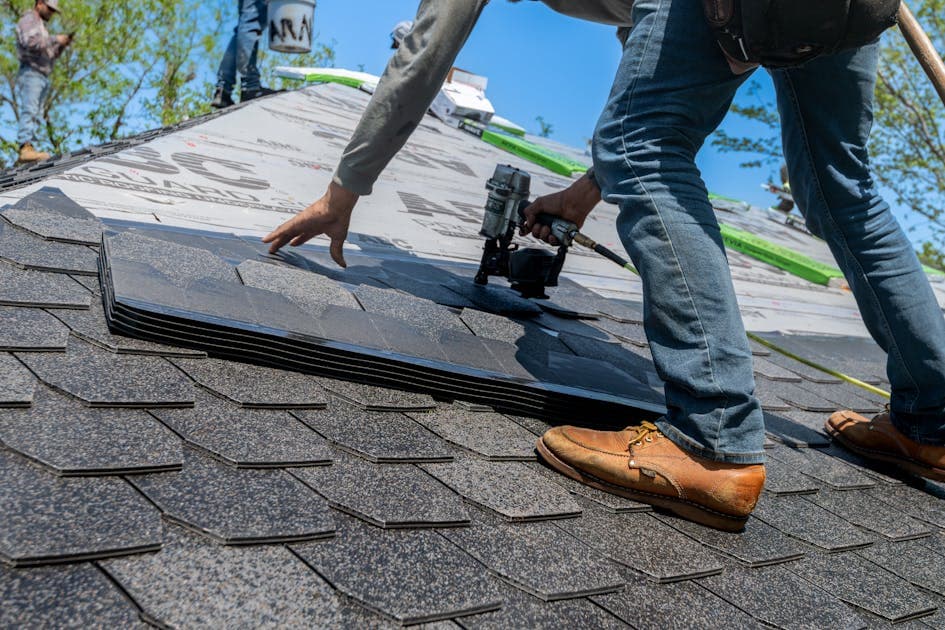
The Number That Should Stop You in Your Tracks
Nearly one in four fall-from-height deaths in construction happen because someone stepped onto a surface that couldn't take their weight. Falls through fragile roofs, mostly fibre cement sheets and rooflights, make up 22% of all fall-from-height fatalities in the industry. That's not a small print statistic. That's a huge chunk of the people who die at work each year, gone because a roof looked solid and wasn't.
Here's the bit that catches most people out: the majority of these workers weren't roofers. They were bricklayers up there fixing a ridge tile, scaffolders taking a shortcut across the top, gutter cleaners, solar panel fitters, telecoms engineers, maintenance lads sent up for a five-minute job. Most of them had no idea what was under their feet. Quite a few of them didn't need to be up there at all.
If you ever find yourself on or near a roof, whatever your trade, this one's for you. It might not be your main job, but it's the job that can kill you fastest.
What Actually Makes a Roof Fragile
A fragile surface is any bit of roof that won't safely hold a person's weight plus whatever they're carrying. The safe way to think about it: every roof is fragile until someone competent has told you otherwise. Looks mean nothing here. A roof can look rock solid and still give way the second someone puts their full weight on it.
These are the surfaces that catch people out most often:
- Fibre cement sheets, corrugated or flat, reinforced or not. Treat all of them as fragile, no exceptions. This covers the grey corrugated sheeting you'll see on barns, warehouses, and older industrial units up and down the country.
- Rooflights set into the roof plane. They can look just like the sheet around them, especially once they've picked up dirt, moss, or a coat of paint, and in poor light they're easy to miss entirely.
- Liner panels, the inner sheets on a built-up composite roof system.
- Corroded metal sheets. A metal roof might look fine from a distance while rust and pitting have eaten away at it underneath, particularly around overlaps, fixings, and edges.
- Glass, wired glass included. Wired glass sounds like it should hold, but it can still shatter under weight.
- Rotted chipboard or similar sheet materials. Moisture gets into particle board over time and it loses its strength long before it looks obviously bad.
- Old wood wool slabs, slates, and tiles, especially where they're already worn or damaged.
The rule to work by: if you can't say for certain a roof is safe, treat it as fragile. Assuming a roof will hold you without checking first is exactly the assumption that's cost people their lives.
Who Actually Gets Hurt
There's a common idea that fragile roof deaths only happen to inexperienced roofers who don't know what they're doing. The figures tell a different story. Workers doing short, routine jobs, gutter clearing, a quick tile swap, fixing a rooflight, show up again and again in the injury data. These are people who thought they were doing something ordinary, right up until the surface under them gave way.
It's not just the person who falls who's at risk either. Someone who goes through a fragile roof can hit plant, machinery, mezzanine floors, or racking on the way down. The fall doesn't need to be from a great height to kill someone.
Trades that regularly come across fragile roofs:
- Roofers, working on repairs and refurbishment day in, day out.
- Bricklayers and scaffolders, working on or around roofs as part of the structure itself.
- Solar panel installers, fitting panels to older industrial and agricultural buildings.
- Telecoms engineers, installing or servicing roof-mounted kit.
- Gutter and cladding contractors, cleaning or replacing systems that sit right at the roof edge.
- Building surveyors, walking roofs to check their condition.
- General maintenance workers, up there clearing gutters, swapping tiles, or fixing flashing.
What the Law Actually Asks of You
Two bits of law matter most here: the Work at Height Regulations 2005 and CDM 2015.
The Work at Height Regulations set out a clear order for how you manage work at height:
- Avoid it. Where you can, do the work from below with a MEWP or another suitable platform. Working from the ground floor or a platform removes the risk of falling through the roof entirely.
- Prevent it. If you can't avoid working on the roof, use equipment that stops a fall happening at all. Think full edge protection, guard rails, toe boards, proper working platforms.
- Reduce it. If a fall can't be ruled out completely, use equipment that cuts down the distance and the damage if someone does fall. Fall arrest systems, safety nets, and other collective measures fall in here.
CDM 2015 backs this up for construction projects specifically. If you're planning or managing work that touches fragile surfaces, you need to make sure it's properly resourced and that the people doing it are competent. The principal designer should be flagging fragile roof hazards at the design stage. The principal contractor needs the construction phase plan to spell out how fragile roof work is being controlled.
Regulation 4 of the Work at Height Regulations says all work at height has to be properly planned, supervised, and carried out by people who know what they're doing. That applies whether it's a three-month re-roofing job or a one-hour gutter clean.
The Hierarchy of Controls, Step by Step
When you genuinely can't avoid working on a fragile roof, the order you apply controls in matters:
- Avoid the fragile surface altogether wherever you can. Can the task be done from below? Can you change how the job's done so no one needs to get up there? This is the only control that gets rid of the hazard completely.
- Use a platform or staging that spans the roof and rests on the non-fragile parts of the structure. Crawling boards and roof ladders can work where a full platform isn't practical, but only if the structure underneath can actually take them.
- Fit guard rails and toe boards at the roof edge and around any fragile areas, so no one can get close enough to fall through.
- Use fall restraint, a harness and line set up so the worker physically can't reach the fragile surface. Restraint beats arrest because it stops the fall from happening rather than catching someone mid-fall.
- Use fall arrest only when nothing above is reasonably practicable. It'll stop the fall, but the impact can still cause serious injury.
- Put safety nets underneath the work area as a backup, to cut the consequences of a fall that none of the above has prevented.
Collective protection, guard rails, nets, platforms, has to come before personal protection like harnesses. Harnesses sit at the bottom of the list because they only work if they're fitted right, anchored right, and used right, every single time. One of those going wrong and the harness does nothing for you.
Signs and Making Sure Everyone Knows
Warning notices need to go up on the approach to any fragile surface. The yellow FRAGILE ROOF signs you can get from any safety supplier aren't a nice-to-have. They're often the first thing that tells someone approaching the area what they're walking into.
Signs alone aren't enough though. Anyone working on or near a fragile roof needs to be:
- Informed, told exactly where the fragile surfaces are and what the precautions are.
- Trained, competent with whatever equipment and systems are being used.
- Instructed, shown how to use that equipment, how to get onto the roof safely, and what to do if something goes wrong.
On commercial or industrial sites, contractors need to work with the client to agree how fragile roof work is being managed. The client might well know things about the roof the contractor doesn't, past surveys, repair history, spots that have caused problems before.
Checking a Roof Before Anyone Goes Up
No one should be stepping onto a roof without first working out whether it's fragile. That means:
- Checking what the roof is actually made from, fibre cement, metal, glass, whatever it is.
- Checking how old it is. Older roofs, especially fibre cement from before 2000, are far more likely to be fragile.
- Looking for corrosion, degradation, or damage, rust, pitting, cracking, fixings that are missing or loose.
- Checking whether the roof's already been inspected and confirmed non-fragile by a competent person, and when that was.
- Looking at any existing paperwork, asbestos surveys, structural surveys, condition reports.
For most residential and commercial roofs, the honest answer to "is this fragile?" is "assume yes until you've got proof otherwise." A visual check from the ground doesn't count as proof. Only a proper structural assessment by a competent person confirms a roof is safe.
What to Do If You're Sent Up an Unfamiliar Roof
The most dangerous version of this job is the one where someone's sent up onto a roof they've never seen, on a site they don't know, for what's supposed to be a quick job, and they don't feel able to push back. That's the exact set of circumstances that keeps turning up in fatality reports.
If you're sent onto a roof and you don't know its condition:
- Assume it's fragile until someone proves otherwise.
- Ask the client or site manager what they actually know, when it was last inspected, what it's made of, whether it's been confirmed non-fragile.
- If you can't get a straight answer, treat it as fragile and work through the full hierarchy of controls.
- If the job can be done from below with a MEWP or another method, do it that way. If it can't be done safely from the roof, don't do it from the roof. Report back and say why.
- If you're being pushed to just get up there and see if it holds, that's a red flag. Note who gave that instruction and take it up the chain.
No job is worth your life. The pressure to just get on with it, not make a fuss, climb up and see, that pressure has killed people. Contractors have gone to prison for putting workers on fragile roofs without the right precautions in place. That doesn't help the worker who went along with it and didn't come home.
Where Fragile Roof Incidents Usually Go Wrong
When the HSE looks into a fragile roof fatality, the same patterns come up over and over:
- No risk assessment done for the job. It got treated as routine and nobody flagged the fragility hazard.
- No inspection of the roof before work started. Someone stepped on and the surface gave way underneath them.
- No edge protection anywhere. No guard rails, no barriers, nothing stopping the worker reaching the fragile area.
- No MEWP or platform on site. The work was being done off the roof surface itself rather than from below.
- The worker was on their own. No one saw it happen and no one could raise the alarm straight away.
- The job was short. Someone assumed a quick task didn't need the same controls as a longer one.
Every single one of these is preventable, and none of them need expensive kit or specialist skills to fix. What they need is a bit of planning, a conversation before the ladder goes up, and someone willing to say no if the controls aren't there yet.
Quick Checklist for Fragile Roof Work
Before anyone works on or near a fragile roof, run through this:
- Has the roof been confirmed non-fragile by a competent person? What's the evidence, and when was it checked?
- Can the work be done from below with a MEWP or other platform instead?
- Has the hierarchy of controls actually been followed? Avoidance first, then platform, then guards, then harness last.
- Is full edge protection in place at every fragile area?
- Are warning signs up at every approach to the fragile surface?
- Is the worker trained, instructed, and competent with the equipment being used?
- Does the method statement specifically cover fragile roof work?
- Is there a rescue plan if someone does fall?
- Is the worker on their own? If so, can that change?
If you answer "I don't know" or "no" to any of these, the work shouldn't start until it's sorted. That goes for a full re-roofing contract just as much as a two-hour gutter clean.
Writing RAMS for Fragile Roof Work
A risk assessment for fragile roof work needs to cover:
- Every fragile surface on the roof, identified by location, material, and condition.
- The hierarchy of controls you've applied, and why the higher-level options, avoidance, platform, weren't reasonably practicable.
- The equipment being used, its type, condition, and inspection record.
- How competent and trained the workers accessing the roof actually are.
- The emergency response, how a worker who's fallen gets reached and treated.
- How workers are told about the hazard and the controls before work starts.
A RAMS document that just says "work at height regulations apply" isn't good enough. It needs to name the fragile surface, spell out the controls in place, and explain why those controls were chosen over more effective options that weren't practicable on this job.
RAMS Builder has templates built specifically for roof work and working at height, already loaded with the hazards, controls, and hierarchy steps the HSE expects to see. Worth using rather than starting from a blank page.