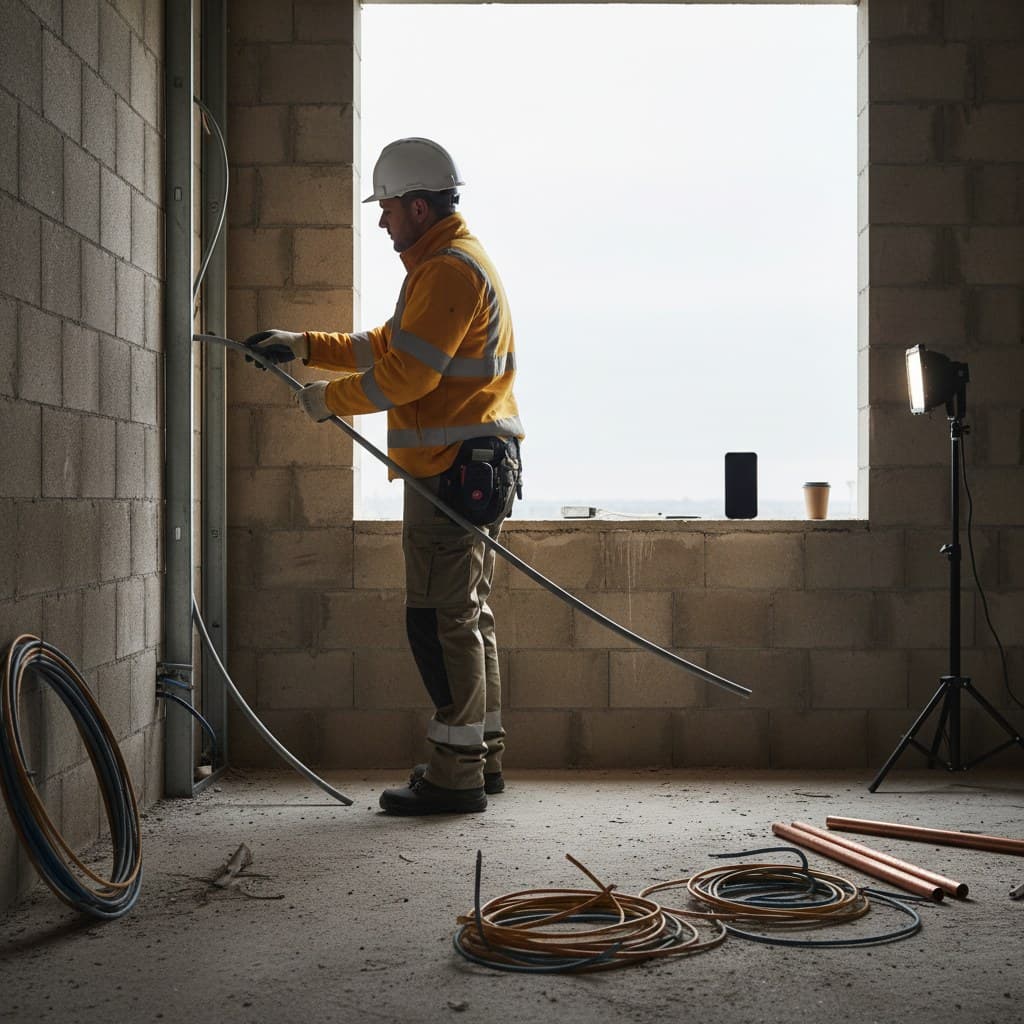
Why Principal Contractors Pick Apart Electrical RAMS More Carefully Than Almost Anything Else
Electrical RAMS for site work are often reviewed more closely than general trade submissions, and electricians can end up making avoidable revisions when the same predictable weaknesses show up.
The pattern is familiar on site: generic hazards, missing calculations, vague controls, and not enough detail about the actual job. Electrical risk assessments carry particular weight because the consequences of a mistake can be severe. Shock, arc flash, and unexpected energisation can all cause life-changing or fatal injuries.
A principal contractor reviewing an electrical RAMS is likely to look carefully at whether the paperwork matches the real job and whether the controls are specific enough to rely on. That means your electrical RAMS has to be tight. Not vague. Not boilerplate. Tight. Every hazard identified specifically. Every control justified. Every risk rating worked out properly with the numbers shown.
The other thing to understand is that electrical hazards split into two distinct groups. First, the electrical hazards proper: shock and arc flash, primarily. Second, everything else that just happens to be present while you are doing electrical work: working at height, manual handling, dust, asbestos. A risk assessment that only mentions the first group is incomplete. RAMS for consumer unit swaps that never mention the manual handling risk of installing a 60kg distribution board is a gap a decent reviewer will spot immediately.
The Five Mistakes That Get Electrical RAMS Rejected
If you can avoid these five, your submission is likely to be clearer, more defensible, and easier for a reviewer to work through. They are predictable weaknesses, and once you know what reviewers are looking for, they are usually fixable.
The first mistake is writing "working with electricity" as your hazard. That is not a hazard. It is an activity description. Your hazard needs to say exactly what could hurt someone, under what circumstances. Something like: "contact with live conductors at 230V AC during safe isolation procedure" or "electric shock from exposed conductors during testing before isolation has been confirmed." "Working with electricity" tells the reader precisely nothing about the actual risks on this job.
The second mistake is putting "wear appropriate PPE" as your main control for electrical shock. PPE is the last line of defence, not the first. If "wear gloves" is your only control, you have skipped elimination (dead working), reduction (reduced voltage systems), and isolation (lock-off and proving dead). A reviewer is likely to flag that immediately.
The third mistake is leaving out the risk rating methodology. You cannot just put numbers in a table without showing your working. What likelihood score did you assign and why? What severity? How did you calculate the initial rating? What does it drop to after controls? Without that working visible, the reviewer has no way of knowing whether your numbers are based on reality or just look plausible.
The fourth mistake is missing the competent person sign-off. Your RAMS must be signed by someone with the right qualifications: NVQ Level 3, City and Guilds 2391 or equivalent, ECS registration. Name, qualification, date. No signature, no document.
The fifth mistake is using the same generic RAMS for every job regardless of site conditions. Electrical work in a new-build with clean, labelled consumer units and known cable routes is nothing like electrical work in a 1960s property with no labelling and potentially non-compliant wiring. Your assessment has to reflect what you will actually find on this site.
The Full Hazard List: All Twelve Categories You Need to Cover
There are twelve distinct hazard categories in a proper electrical risk assessment. Most electricians cover the first two and miss the other ten. Here is the complete list.
Electric shock is the obvious one. In domestic work, you are dealing with 230V AC, enough to kill if current passes through the chest. In three-phase commercial work, you are looking at 400V AC, with significantly higher available fault current. Shock can happen during isolation if you have isolated the wrong circuit, during live working where it has been justified and formally authorised, during testing before isolation is confirmed, and during fault finding where the fault itself makes normal isolation impossible. Each scenario needs separate assessment because the controls are different.
Arc flash is the second primary hazard and it is frequently omitted. An arc flash produces temperatures reaching approximately 19,000 degrees Celsius. It causes severe burns, permanent eye damage from the light, and a pressure wave that can throw someone across the room. It happens during switching operations, when racking circuit breakers in and out of live switchgear, during fault conditions, and when using test equipment on live circuits in a fault state. This is not rare. It happens in routine switching. For any work on or near exposed live conductors, you have to assess arc flash.
Cable strikes are one of the most common injuries on construction sites, and they are frequently missing from RAMS. The hazard is obvious: you are drilling into a wall without knowing where the cables run. The injury is not always the shock. It is the involuntary reaction when you hit a cable: you jerk away, you drop the drill, you fall from height, you drive the bit further into your hand. In renovation work, existing wiring might not be documented, might not follow standard routes, might have been modified by previous contractors in ways that make no sense at all.
Asbestos is mandatory if you are working in any property built before 2000. Consumer units and their enclosures, older cables with rubber or fabric insulation, older switch and socket front plates, older light fittings, any of these could contain asbestos. Asbestos disturbance is notifiable under the Control of Asbestos Regulations 2012. Exposure causes mesothelioma, asbestosis, and lung cancer, diseases that take 20 to 40 years to develop. Your RAMS has to either confirm a survey has been done and no asbestos is present, or specify controls for suspected asbestos.
Dust from drilling and chasing is a respiratory hazard under COSHH Regulations 2002. Silica dust from drilling into brick, block, stone, or concrete is carcinogenic. It causes silicosis and is classified as a cause of lung cancer. Wood dust from cutting cable timbers and battens can cause occupational asthma, nasal cancer (particularly from hardwood dusts), and contact dermatitis. FFP2 for most dust-generating tasks, FFP3 for engineered wood products containing formaldehyde-based resins.
Manual handling: distribution boards, large consumer units, heavy cable drums. These all need assessing under the Manual Handling Operations Regulations 1992. For heavier items, that means specifying mechanical aids or a team lift with a clear communication protocol. "Use appropriate technique" is not a control measure.
Working at height: accessing loft voids, elevated distribution boards, ceiling roses, running cables in roof spaces. The Work at Height Regulations 2005 apply. Your RAMS has to specify access equipment, precautions, and how you will manage emergencies if someone falls.
The remaining categories are: contact with other services (gas, water, data, telecoms running alongside electrical cables); slips and trips from trailing cables and wet or uneven surfaces; work in confined spaces (loft voids, under-floor voids, inspection chambers); biological hazards (bird droppings, rodent infestations, standing water); and manual dexterity hazards from working in cramped positions for long periods.
Safe Isolation: The One Control Everything Else Depends on
For any work on electrical conductors, dead working is the default. Your RAMS has to describe the safe isolation procedure in full, specific terms. "Isolate before work" is not a safe isolation procedure. It is a statement of intent that any competent reviewer will see straight through.
The safe isolation procedure for low voltage work follows these steps in this order.
First, identify and locate all circuits relevant to the work, including all supplies that could energise the area. This might mean talking to the client or building manager, checking circuit charts and drawings, and visually identifying circuits in the consumer unit or distribution board.
Second, isolate at the main isolation point, typically the main switch or the relevant circuit breaker. Note that some circuits, inverter outputs, standby power systems, might not be isolated by the main switch and need specific attention.
Third, prove dead using a calibrated two-pole voltage indicator that meets GS38. GS38 is the HSE's guidance on voltage indicators. It specifies exactly what the indicator must be capable of detecting and how it must be used. A standard multimeter that does not meet GS38 is not acceptable.
Fourth, apply personal lock-off devices, a hasp and padlock securing the isolation point in the off position. A switch can be accidentally or deliberately reclosed. Lock-off prevents that.
Fifth, apply a danger tag to the lock.
Sixth, re-prove dead at the point of work before you start. The circuit could theoretically have been re-energised between the first proving and this step.
The GS38 reference matters. If your RAMS describes safe isolation without mentioning GS38, a reviewer with any electrical knowledge will notice immediately. Document the specific GS38-compliant instrument you are using. Name the type and confirm its calibration status.
Cable Avoidance: Preventing the Most Common Electrical Injury on Site
Cable strikes cause more electrical injuries on construction sites than any other single activity. The injury is often not from the shock. It is from the involuntary reaction when you hit a cable. You jerk, you fall, you drive the drill further into your hand. These are entirely preventable with proper survey procedures.
For any penetrative work, drilling walls, chasing, cutting, nailing into surfaces where cable routes are not definitively confirmed absent, your RAMS has to address cable avoidance.
The procedure is as follows. Commission a cable avoidance survey using a Cable Avoidance Tool (CAT) and signal generator (Genny) at least 72 hours before penetrative work begins, where possible. The operator must be trained. A CAT that is switched on without the correct mode selected might not detect all services, particularly non-power cables and non-metallic pipes.
Review builder's drawings and any available electrical installation drawings, but treat them as indicative only. Actual cable routes frequently deviate from drawings in ways that make no logical sense.
Mark all identified cables on the work surface in fluorescent chalk. Work with hand tools only within 50mm of any identified cable route. Power tools need a bigger safe distance because they drive into surfaces more aggressively. If penetrations within 50mm of an identified cable route cannot be avoided, speak to the site manager or principal contractor before proceeding. Do not guess.
Arc Flash: What Your RAMS Needs to Say
Arc flash assessment is often missing from electrical RAMS, and reviewers who understand the hazard will usually pick that up quickly. Arc flash occurs when an electrical arc creates a plasma with temperatures exceeding 19,000 degrees Celsius. The thermal energy causes severe burns. The pressure wave can damage lungs and internal organs. The sound energy can cause permanent hearing damage. For work involving switching operations, exposed live conductors, or fault conditions, it needs to be considered explicitly.
The arc flash boundary and required arc rating for most low voltage work in the UK can be determined using HSG85 (the HSE's guidance on arc flash) or using data from the host employer or principal contractor for commercial and industrial installations.
For domestic work, arc flash hazard is generally lower due to lower available fault currents, but it is not zero. Particularly for work on the supply side of the meter, on distribution boards with high prospective fault currents, or on circuits with significant inrush currents from motors or transformers.
Controls include: limiting the energy available at the point of work through selective coordination of protective devices; reducing clearing time through fast-clearing protective devices; increasing working distance from exposed live parts where possible; and arc-rated PPE with an ATPV rating appropriate for the calculated incident energy level. Your risk assessment should reference the arc flash hazard and specify the controls you will apply.
Legislation and Standards: What a Competent RAMS Must Reference
A competent electrical risk assessment references the relevant legislation and guidance.
The primary legal instrument is the Electricity at Work Regulations 1989. Regulation 4 imposes the duty to avoid danger from live or potentially live conductors. Live working is only permitted when it is necessary for the work and cannot reasonably be avoided, and it must be carried out under controlled conditions with appropriate justification and supervision. Reference Regulation 4 if any live working is anticipated.
Building Regulations Part P applies to all domestic electrical work in England and Wales. It requires that domestic electrical work be carried out by a competent person, someone registered with a Part P self-certification scheme or subject to an appropriate inspection and testing regime by a building control body. Confirm your competency basis in the RAMS.
BS 7671:2018+A2:2022, the 18th Edition of the IET Wiring Regulations, is the technical standard for electrical installations. While compliance is not a legal requirement in itself, it represents the accepted standard of good practice that HSE and courts expect electrical workers to follow. A RAMS that identifies non-compliant conditions or requires work below BS 7671 would be inadequate.
GS38 and HSG85 provide the specific technical benchmarks for safe isolation and arc flash respectively. These are freely available from the HSE website. If your risk assessment does not reference GS38 for safe isolation or HSG85 for arc flash, a reviewer with electrical knowledge will notice.
Worked Example: First Fix in a New-Build Property
Let us walk through a first-fix electrical installation in a new-build three-bedroom house. The job involves running cable from the consumer unit location to each socket outlet, switch, and light fitting. The work includes working at height accessing ceiling voids, manual handling of cable drums and light switch boxes, working with sharp tools for cable stripping and cutting cable ties, and working in a dusty environment drilling and chasing.
The primary electrical hazards are: electric shock during testing before isolation is confirmed, cable strikes during first-fix penetrations, arc flash during any work on the distribution board, and the non-electrical hazards listed above.
For the cable strike hazard, the initial risk rating might be Likelihood 3 (Occasional: cable routes are known from drawings but drawings may not be fully accurate) multiplied by Severity 4 (Major: cable strike at 230V could cause fatal electric shock and secondary injuries) equals Risk Rating 12 (High). After controls, CAT and Genny survey carried out, cables marked, cables assumed to run horizontally to nearest junction box and vertically to floor and ceiling levels as well as along documented routes, hand tools used within 50mm of identified routes, power tools prohibited within 50mm of identified cable routes, the residual rating might be Likelihood 1 (Improbable) multiplied by Severity 4 equals Risk Rating 4 (Low).
That reduction from 12 to 4 demonstrates the cable avoidance procedure works and justifies proceeding under the specified conditions.