Why Painters and Decorators Need a Risk Assessment
The Health and Safety at Work Act 1974 says every employer and self-employed worker must identify and control risks in their work. For painters and decorators, that means a written risk assessment. It's not optional and it's not a box-ticking exercise. The HSE identifies painting and decorating as a trade with higher-than-average cancer risk, linked to past exposures to solvents, lead, and dust. The work hasn't got safer just because paint technology has changed. You're still working with chemicals, you're still working at height, and you're still generating dust.
A proper risk assessment does two things. It keeps you and anyone else on site safe. And it gives you something to show if the HSE turns up. Inspectors look for site-specific assessments, not generic templates with the blanks left empty. They want to see you've thought about the actual job you're doing, in the actual place you're doing it.
What the Law Says
Three pieces of legislation sit on top of painting and decorating work:
- Health and Safety at Work Act 1974: the general duty to protect yourself and others affected by your work.
- Control of Substances Hazardous to Health (COSHH) Regulations 2002: you must assess exposure to every hazardous substance you use and put controls in place.
- Work at Height Regulations 2005: applies whenever you use ladders, stepladders, hop-ups, scaffold towers, or MEWPs.
If you work with five or more people, the risk assessment has to be written down. Sole traders don't legally need to write it down, but doing it anyway is the only way to prove you've done it if someone asks.
The Hazards to Look For
Painting and decorating brings a mix of chemical and physical hazards. Here's what to cover in your assessment.
COSHH: Paints, Solvents, and Dust
This is the one HSE inspectors check first. Every product you use needs a COSHH assessment: paints, varnishes, thinners, strippers, fillers, adhesives, primers, and any two-pack coatings. You need to know the exposure route for each one: inhalation, skin contact, or ingestion. For most decorating jobs, inhalation of solvent vapours and skin contact with wet paint are the main routes.
Ventilation is your first line of defence. Open windows and doors. Use fans to push fresh air through the work area. If that's not enough (spray painting, solvent-heavy products, confined spaces), you need respiratory protective equipment. For sanding down old surfaces, you need dust masks as a minimum, and extraction on power sanders if you have it.
Don't forget skin protection. Solvents and epoxy resins strip oils from your skin. Barrier creams help, but proper gloves matched to the product you're using are better. Check the safety data sheet for the right glove type. Nitrile gloves handle most decorating products. Latex doesn't.
Working at Height
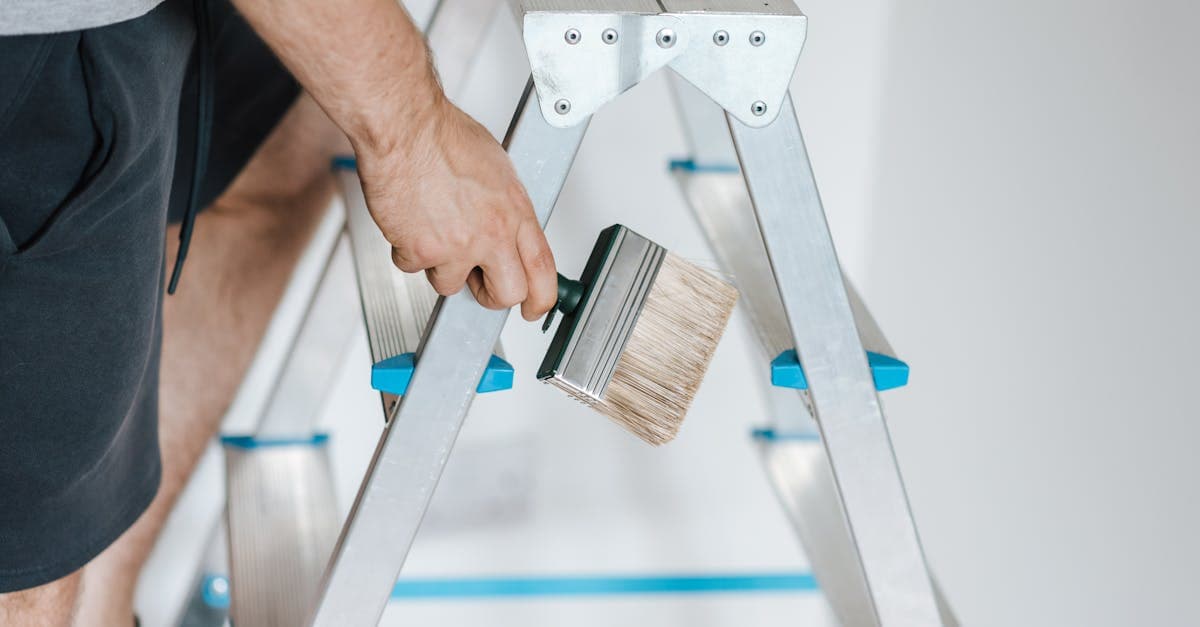
Decorators work at height every day. Ceilings, stairwells, the tops of walls. The Work at Height Regulations 2005 don't ban ladders, but they do say you need to justify your choice of equipment. A step ladder in a furnished room with a flat floor is probably fine for cutting in around a ceiling. The same step ladder on a staircase isn't.
For anything that takes longer than 30 minutes at height, the HSE expects you to consider a working platform instead of a ladder. Hop-ups, trestles with scaffold boards, and small scaffold towers are all options. The key is matching the equipment to the task and the site conditions. Your risk assessment should name the specific equipment you'll use and explain why it's the right choice.
Ladder checks matter too. Before you set foot on one, check the feet, the rungs, the stiles, and the locking mechanism on stepladders. If it's damaged, tag it out and don't use it. Write the checks into your assessment.
Manual Handling
Paint tins aren't light. A 10-litre tub of emulsion weighs about 15kg. Move enough of them around a site and your back will feel it. The same goes for plasterboard, sandbags, and access equipment. Your risk assessment should note the heavy items you'll be handling and how you'll move them: trolleys, two-person lifts, breaking loads into smaller trips.
Awkward postures are just as much a manual handling issue as weight. Sanding skirting boards, painting behind radiators, cutting in at floor level. These force your body into positions it wasn't designed to hold for long periods. Rotate tasks where you can. Take breaks. Use extension poles on rollers to avoid overreaching.
Electrical Safety
Decorating means working around sockets, switches, and light fittings. Before you start sanding or using water-based products near electrics, isolate the circuits you'll be working near. Take light fittings down rather than trying to paint around them. It's faster, neater, and safer.
Power tools need checking too. Look at the cable, the plug, and the casing before you use a sander or a heat gun. If you're on site with 110V kit and a transformer, check the transformer as well. PAT testing isn't a legal requirement on its own, but it's how you prove electrical equipment is safe. Most commercial sites won't let you through the gate without it.
Lone Working and Occupied Properties
A lot of domestic decorating is done solo. You turn up, you paint, you leave. If you're working alone, someone should know where you are and when you expect to finish. A simple text check-in at lunchtime and end of day covers it. If you're using ladders or solvents while working alone, the risk is higher. Someone should be able to raise the alarm if you don't check in.
Working in occupied properties adds another layer. Children, pets, elderly residents. They're not your responsibility in the same way they would be if they were your employees, but you still need to keep them safe. Keep chemicals out of reach. Clean up spills straight away. Don't leave tools lying around. If you're using solvent-based products, warn the occupants about fumes and make sure they can stay out of the work area.
Lead Paint and Asbestos
Any property built before 1978 might have lead paint on the walls or woodwork. Sanding or stripping it releases lead dust and particles into the air. If you suspect lead paint, stop and get it tested before you start sanding. The same goes for asbestos. Artex ceilings, old floor tiles, insulation board around pipes. If you don't know what it is, treat it as suspect until you've had it checked.
The HSE's cancer and construction research identified painters as a trade with elevated cancer risk, and some of that is down to historical asbestos and lead exposure. The risks are lower now than they were 50 years ago, but they haven't gone away.
Fire Risk
Paints, solvents, and thinners are flammable. Rags soaked in linseed oil or certain varnishes can self-heat and catch fire if they're screwed up and left in a pile. Lay them out flat to dry before disposal, or put them in a sealed metal container. Keep solvents away from ignition sources, including the pilot light on a boiler you might be painting around.
How to Structure Your Risk Assessment
A risk assessment for a painting and decorating job doesn't need to be complicated. The HSE's five-step approach works:
- Identify the hazards: walk the site before you quote. Look at access, surfaces, electrics, and ventilation.
- Decide who might be harmed: you, other trades on site, the occupants, anyone walking through.
- Evaluate the risks and put controls in place: for each hazard, write down what you'll do to reduce the risk to an acceptable level.
- Record your findings: write it down. Date it. Sign it.
- Review and update: if something changes on the job, update the assessment.
Be specific. Don't write "use PPE" when you mean "nitrile gloves for handling white spirit, FFP3 mask for sanding, and safety glasses when working overhead." Don't write "work at height safely" when you mean "step ladder with a 1.2m platform height for cutting in walls, checked before use each day." The detail is what makes the assessment useful and what satisfies an inspector.
Using RAMS Templates
A RAMS document combines your risk assessment with a method statement: how you'll do the work safely. For painters and decorators, a good RAMS template saves you starting from scratch for every job. You fill in the site-specific details, the products you're using, the access equipment, and any special conditions. The structure is already there.
The template doesn't replace thinking. It just means you're not reinventing the wheel every time you quote for a new job. The site-specific bits are where the real risk management happens.