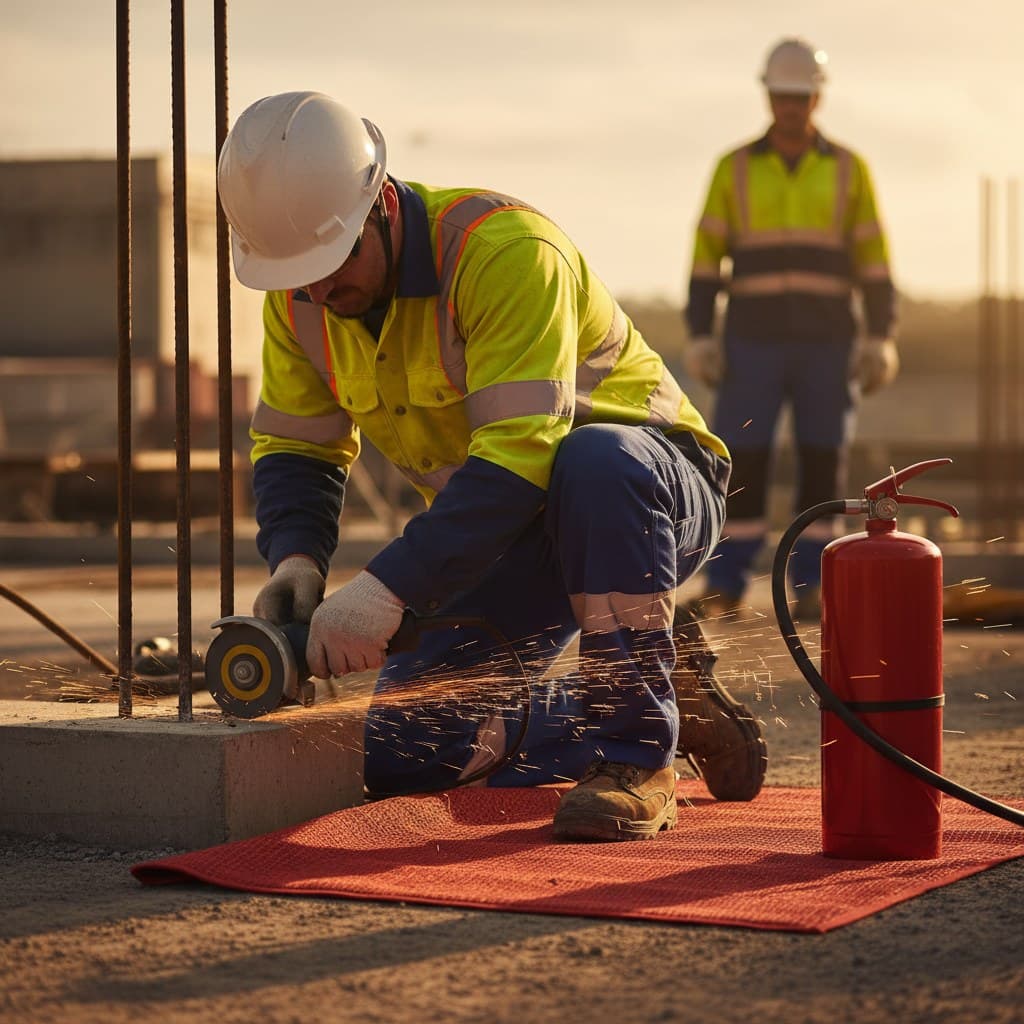
You've got a welding, cutting or grinding job booked on site, and the site manager wants a hot work permit and a RAMS before you strike an arc. Usually nobody explains what either document needs to say, where the rules come from, or how long a fire watch actually runs.
It matters because hot work is a common cause of fires on construction sites. Sparks travel further than people expect, heat starts fires on the far side of walls, and smouldering in a cavity can sit unnoticed for hours. The paperwork is how you show the risk was controlled before, during and after the job.
This guide covers what the law actually requires, what is guidance or an insurance condition, and what to write in your welding risk assessment and RAMS so it reads like it belongs to your job on your site.
Quick answer
The short version
Welding and hot work safety on a construction site comes down to four things: control the fire risk with a permit, area preparation and a fire watch, control welding fume with LEV and suitable RPE, store and use gas cylinders correctly, and write all of it into task-specific RAMS. The permit itself is not named in law, but it is the recognised way to show the fire risk is controlled.
Welding Safety on Construction Sites: What Counts as Hot Work
Hot work is any task involving naked flames, applied heat, or sparks and friction hot enough to ignite material. That covers arc welding (MMA, MIG, TIG), gas welding and cutting, brazing, soldering, angle grinding and disc cutting, and torch-applied coatings such as roofing felts. Grinding counts, even though it feels like a different job. Sparks off a disc are hot enough to set fire to dust, packaging, solvents and debris.
The reason hot work starts so many fires is that sparks and heat travel further than people expect. A spark can spray several metres and roll into a gap. Heat conducts through steel and sets fire to the timber sole plate bolted to the other side of the beam. Openings, cracks, doorways and service voids carry sparks into cavities you cannot see from where you are standing.
Fires that start this way often smoulder before they flame, so they show up after you have packed up and gone home. That is why a lot of hot work safety is about what happens after the welding stops, not just during it.
What the Law Actually Requires
The Fire Duties Behind Every Hot Work Job
No UK regulation uses the words "hot work permit". The legal duties are real all the same, and they stack up.
The core duty is regulation 29 of the Construction (Design and Management) Regulations 2015 (CDM 2015). Where construction work is carried out, suitable and sufficient steps must be taken, so far as is reasonably practicable, to prevent risk of injury from fire or explosion. Regulations 30 to 32 back it up with duties on emergency procedures, emergency routes and exits, and fire detection and fire-fighting.
The Regulatory Reform (Fire Safety) Order 2005 applies as well. The responsible person must take general fire precautions so far as is reasonably practicable (article 8), make a suitable and sufficient fire risk assessment (article 9), and provide fire-fighting equipment, detectors and alarms where needed (article 13). HSE's position is that on a construction site the responsible person is usually the main or principal contractor in control of the site.
DSEAR 2002, the Dangerous Substances and Explosive Atmospheres Regulations, also applies to construction sites. It covers flammable gases used for welding and cutting, gases under pressure since 2015, and hot work on tanks, drums and pipework that have contained flammable material. DSEAR exists because hot work on containers and pipework that still hold flammable residue has caused fatal fires and explosions. DSEAR's approved code of practice, L138, covers permits to work where DSEAR applies.
We cover the wider picture, including extinguisher choice and fire points, in our guide to construction phase plans, which is where hot work rules and emergency arrangements are planned before work starts. This article stays on the hot work itself.
Where the Hot Work Permit Fits
So where does the permit come from? Not from a statute. HSE guidance HSG168, Fire safety in construction, recommends that hot work be controlled by a permit-to-work system where it cannot be avoided. Most contractors' insurance policies carry a hot work condition, often tied to the Joint Code of Practice on fire prevention on construction sites, requiring a written permit and a fire watch. Breach the condition and the insurer can refuse a claim.
Treat the permit as the recognised control method, not a standalone legal instrument. But be clear about the stakes. HSG168 is guidance, and if there is a fire and you were not following it, you will be expected to justify what you did instead. A signed permit is the simplest way to show the fire duty was taken seriously.
The Hot Work Permit: One Task, One Place, a Set Time
HSG168 sets out what a permit should cover: the location and nature of the work, the proposed time and duration, the limits of validity, the precautions before, during and after, the alarm procedure, the person in direct control of the work, and the person authorising and closing it. One defined task, in one defined place, for a set time.
That is why blanket authorisation fails. A permit that says "welding, level 2, all week" is not a control, it is a signature. It says nothing about what changed on level 2 between Monday and Friday, who checked the area, or when the fire watch finished.
Who issues and signs it? Only people with clearly assigned authority. On a site with a principal contractor, the duty usually sits with them, because CDM 2015 reg 13 makes the principal contractor responsible for planning, managing and monitoring the construction phase. If you are the only contractor, the reg 15 duties are yours. You plan, manage and monitor your own work, and under regs 15(5) and 15(6) you draw up the construction phase plan yourself before setting up the site.
Reg 15 also shapes who does the work. Under reg 15(7) you must not appoint anyone who lacks the skills, knowledge, training and experience for the job. Under reg 15(8) you provide supervision, instructions and information, and reg 15(9)(b) specifically includes the procedures to follow in the event of serious and imminent danger. A fire on site is exactly that, so the alarm, evacuation and assembly arrangements belong in the same briefing as the task.
The permit is closed once the fire watch and final checks are done. Keep the record. After an incident, the permit is the evidence of what was checked, by whom and when.
Preparing the Area Before Any Arc or Flame
The first question is whether you need hot work at all. Cold cutting, mechanical fixings and off-site fabrication remove the risk completely. HSG168 suggests routine hot work such as steel cutting happens in a designated area away from combustible material and the main structure, not wherever happens to be convenient.
Where hot work has to be done in place, prepare the area. Remove combustible material or protect it with fire-resisting sheets. Insurance conditions and the Joint Code of Practice commonly require combustibles within about 10 metres of the work to be removed or protected. That 10 metre figure is an insurance and industry expectation, not a legal measurement, but treat it as the default and check your own policy wording.
Then check the other side. Look at what sits behind the wall, below the floor and inside the cavity where you are working. Seal openings, cracks, doorways and voids with fire blankets or non-combustible sheeting so sparks and hot gases cannot travel.
Fire-fighting kit comes next. HSG168 expects at least two suitable fire extinguishers within reach of the hot work and the fire watch position, matched to the likely fire: water for timber and paper, dry powder or foam for flammable liquids, CO2 for electrical equipment. Nominated people should be trained to use them.
Checklist
- Combustibles removed or sheeted within the clearance zone.
- Other side of walls and floors checked and openings sealed.
- At least two suitable fire extinguishers in reach of the work and the fire watch.
- Permit issued for this task, this location, this time window.
- Fire watch named, briefed and timed, including after-work checks.
- Gas cylinders upright, chained and stored correctly.
- Suitable RPE or LEV in place for the fume.
The Fire Watch: How Long and What For
A fire watch is a named person whose only job is to watch for fire. Not the welder keeping half an eye out while working, and not whoever is nearest. They watch during the work and during breaks, they know how to raise the alarm, and they have extinguishers within reach.
Under HSG168, the watch continues after the work stops. The guidance figures are a continuous fire watch of the area for at least an hour after hot work ends, then at least one further check two hours after the end. All hot work should be finished two hours before the end of the working day so the checks happen while people are still on site, and site security should be told to keep an eye on former hot work areas.
Those timings are guidance, not a single legal number. In timber-framed buildings, roof voids and cavities, smouldering develops slowly, so the watch should be longer, and any extension gets recorded on the permit.
Source-backed note
HSE note
Welding Fume, LEV and RPE
Hot work safety is not only about fire. HSE strengthened its enforcement expectations for welding fume after scientific evidence assessed by IARC, and endorsed by HSE's Workplace Health Expert Committee, led to mild steel welding fume being reclassified as a human carcinogen. All welding fume, including mild steel, can cause lung cancer, and fume is also linked to metal fume fever, pneumonia and occupational asthma.
HSE's position is blunt. General ventilation does not achieve the necessary control. Indoors, engineering controls such as local exhaust ventilation (LEV) are expected for welding. Where LEV alone does not adequately control exposure, add suitable RPE. Outdoors, LEV cannot reliably capture the fume, so suitable RPE is needed, and think about anyone else near the work. HSE points to a powered air or supplied air respirator, with an assigned protection factor of at least 20, as often the best option for arc welders. Tight-fitting RPE must be face-fit tested, and the wearer needs to be clean-shaven at the seal.
LEV carries its own duties. Under reg 9 of COSHH 2002, LEV must be thoroughly examined and tested at least every 14 months, with records kept for at least five years. If you buy or hire extraction, book the test. Owning the unit is not the same as controlling the exposure.
Two more points that get missed. Design the job so less welding is needed where you can, because cold joining and mechanical fasteners remove the fume entirely. And remove grease, paint and coatings before welding, since heated coatings can give off toxic components. We cover substance control more widely in our guide to COSHH essentials for builders.
Gas Cylinder Safety on Construction Sites
Oxy-fuel cutting and welding bring flammable gases and oxygen onto the site, and acetylene in particular is unforgiving. It can decompose explosively even without air or oxygen, so its handling comes with extra rules.
Storage first. Cylinders stay upright and are chained to a rack or trolley so they cannot fall. Keep them in a safe, well-ventilated place, preferably outside buildings. Never keep or use cylinders below ground level or next to drains, basements and other low-lying places, because heavy gases will not disperse. Change cylinders away from ignition sources, and use propane in preference to acetylene where the job allows.
Equipment matters as much as storage. Fit flashback arresters on the pressure regulators on both the fuel gas cylinder and the oxygen cylinder. Fit non-return valves at the torch, inspect them regularly and replace damaged ones. Know the limit: acetylene pressure must not exceed 0.62 bar (9 psi) unless the equipment is specifically designed for it. Keep grease and oil away from oxygen fittings entirely. At the end of the day, turn off the cylinder valves, purge the hoses, then close the blowpipe valves.
Important safety warning
If an acetylene cylinder has been heated, or was involved in a flashback or fire you could not extinguish at the torch, it can explode hours later. Do not approach it or try to move it. Evacuate the area, call the fire and rescue service, and tell them acetylene is involved.
Arc Eye, Screens and Protective Equipment
Arc eye is the painful inflammation caused by ultraviolet light from the welding arc. The welder needs eye protection with the correct shade of filter for the process, and everyone else needs shielding from direct and reflected arc light. Welding curtains and screens protect nearby workers and should conform to BS EN ISO 25980 or give the same level of protection. Reflected UV off shiny surfaces catches people out, so screen the reflection, not just the arc.
Clothing covers arms and legs, and gauntlets are standard. Goggles go on for chipping slag and wire brushing, because slag pops. The duty to provide suitable PPE sits in the Personal Protective Equipment at Work Regulations 1992, as amended by the Personal Protective Equipment at Work (Amendment) Regulations 2022.
Grinders and Abrasive Wheels
Angle grinders and chop saws used for cutting and preparing steel are work equipment under PUWER 1998, which covers welding sets too. PUWER reg 9 requires adequate training for everyone who uses work equipment, and for those who supervise them, covering the risks and the precautions.
The Abrasive Wheels Regulations 1970 were revoked by PUWER 1998, so there is no separate abrasive wheels law today. Current guidance is HSG17, and recognised training schemes exist for mounting wheels. In practice: guards stay on, discs are matched to the machine and the material, and discs are inspected before use.
What Goes Into a Welding Risk Assessment and RAMS
This is where the site manager's request and the law meet. Your risk assessment and RAMS need to describe this job, in this place, with this kit. Start with the facts: the task, the location, the equipment, the people and the sequence of work. Then work through the phases: prep (area clearance, screening, cylinders), hot work (fume, arc, gas) and cool-down (fire watch, final checks). The cool-down phase is where most RAMS go thin.
For each hazard, write controls that name things. Who issues the permit. What gets removed or sheeted, and how far the clearance zone runs. The extinguisher count and type. The fire watch by name, with timings that include the hour after work ends and the two-hour check. The emergency procedure: alarm, evacuation route, assembly point, who calls the fire service. A control nobody can check is a control that does not exist.
Weak wording vs better wording
Weak
Better
If you are building the documents from scratch, our step-by-step risk assessment guide walks through the process, and our guide on how to write RAMS for construction work covers the method statement side in detail.
Common mistakes
- Treating a generic permit as blanket authorisation for the week.
- Packing up the fire watch the moment the arc stops.
- Welding next to combustibles because it is only a quick job.
- Relying on general ventilation for welding fume indoors.
- Storing cylinders on their side, loose, or below ground level.
- RAMS that name no fire watch and no emergency procedure.
Next step
Get your RAMS sorted
RAMS Builder helps small UK contractors write trade-specific RAMS and method statements for welding, cutting and grinding, so the permit conditions, fire watch timings and fume controls are written down per task instead of copied from a generic template.